



At Mars, we believe the world we want tomorrow starts with how we do business today. Building that future requires more than a bold vision; it demands groundbreaking science, open collaboration and an unwavering commitment to nurturing the scientific leaders of tomorrow.
This belief lies at the heart of our long-standing partnership with the Lindau Nobel Laureate Meetings, an extraordinary global forum that brings together Nobel Laureates and hundreds of the world’s most promising young researchers on the banks of Lake Constance in Germany.
Following last month’s landmark event, we are reflecting on a week defined by curiosity, interdisciplinary connection and pioneering scientific dialogue. This year’s gathering was especially significant, marking the historic 75th anniversary of the Lindau Nobel Laureate Meetings and bringing together over 70 Nobel Laureates and 600 young scientists from across the globe to collaborate on shaping a better future.
Go inside the 75th Lindau Nobel Laureate Meetings with Mars Associates, Nobel Laureates and the next generation of global scientific leaders.
Our collaboration with the Lindau Meetings began in 2007, and this year, we are thrilled to mark an exciting new chapter in this relationship. Through the newly established Mars Impact Fund, our enterprise-level entity designed to invest in strategic, long-term partnerships, Mars has awarded a three-year, €1.5 million grant to the Lindau Nobel Laureate Meetings.
This grant is a premier example of our commitment to growing and diversifying the global pipeline of scientific talent. By removing financial barriers to participation, this funding will double our support, expanding our sponsorship from 15 to 30 young scientists annually starting next year. Known as "Mars Fellows," these promising early-career researchers from institutions worldwide are empowered to bring their diverse perspectives to the global stage, collaborating across generations, sectors and disciplines to tackle the world's most urgent challenges.
We bring this strategic partnership to life through direct mentorship and deep engagement throughout the week. A standout highlight of this year's event was the Mars Fellows Dinner, where our sponsored researchers connected directly with senior Mars science leaders and technical experts. This gathering provided a unique, personal space for lively Q&A sessions, mutual learning and scientific exchange, demonstrating how we actively bridge the gap between academic discovery and industry application to champion the next generation of talent.
Last month’s milestone meeting was dedicated to the power of interdisciplinary science, and Mars was proud to host several flagship events designed to push the boundaries of traditional research.
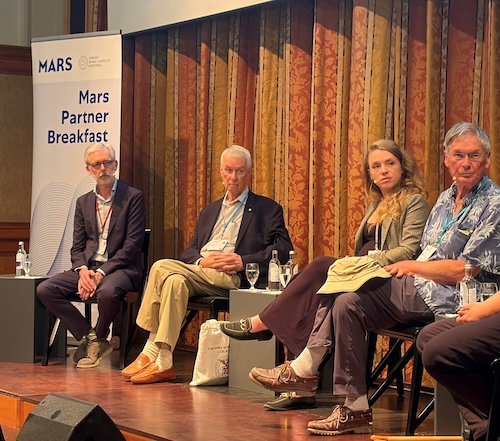
At our Partner Breakfast, we posed a critical question to the scientific community: Has the limiting factor in modern science shifted from our ability to generate data to our ability to integrate, interpret and act on it?
Led by Dr. Hagen Schroeter, Chief Science Officer of Mars Food & Nutrition, the discussion featured Masaryk University researcher Lucie Ráčková alongside Nobel Laureates Sir Tim Hunt and Sir Richard Roberts. This panel marked an exciting first for Mars at Lindau, bringing together two Nobel Laureates to discuss how cross-disciplinary collaboration can unlock actionable insights to drive evidence-based innovation in global health and nutrition.

In another highly anticipated session, Mars Chief Science Officer Dr. Abigail Stevenson, Mars Food Safety Expert James Marshall, and Prof. Dr. Philippe Schmitt-Kopplin, Director of the Research Institute Analytical BioGeoChemistry at Helmholtz Zentrum Munich, explored the power of non-targeted analysis in deciphering complex biological and food systems. In a thrilling first for the Lindau Meetings, the dialogue featured a live, real-time case study broadcast from the Arctic Circle using Starlink technology. This live data demonstration brought the cutting-edge analytical approach to life, demonstrating how real-time insights can safeguard global supply chains and environmental health, representing a major highlight that was exceptionally well-received by the attending young scientists.


