



With a new bottom-up calculation model, Mars and Quantis outline an approach to accounting for the CPG sector's retail GHG emissions and the consumer last-mile.
The climate program at Mars is grounded in science, ensuring that our targets are informed by the latest up-to-date research. It is fully inclusive, addressing emissions and impacts across the entire value chain, both upstream and downstream of our own operations. This includes retail partner greenhouse gas (GHG) emissions from stores, warehouses and transport, as well as our share of the consumer transportation footprint associated with last-mile travel to and from retail stores.
Data is key to understanding and managing climate impact. The Mars Retail Footprint Calculator, co-developed with Quantis, demonstrates how Consumer Packaged Goods (CPG) companies, like Mars, can better understand their retail and last-mile GHG emissions. This tool has enabled a transition from high-level estimates based on sales value to a data-driven model grounded in life-cycle analysis, based on physical flows of finished goods. This empowers Mars to measure GHG emissions and take action to reduce them.
The calculator is used to quantify our share of retail and last-mile GHG emissions as shown in Figure 1.
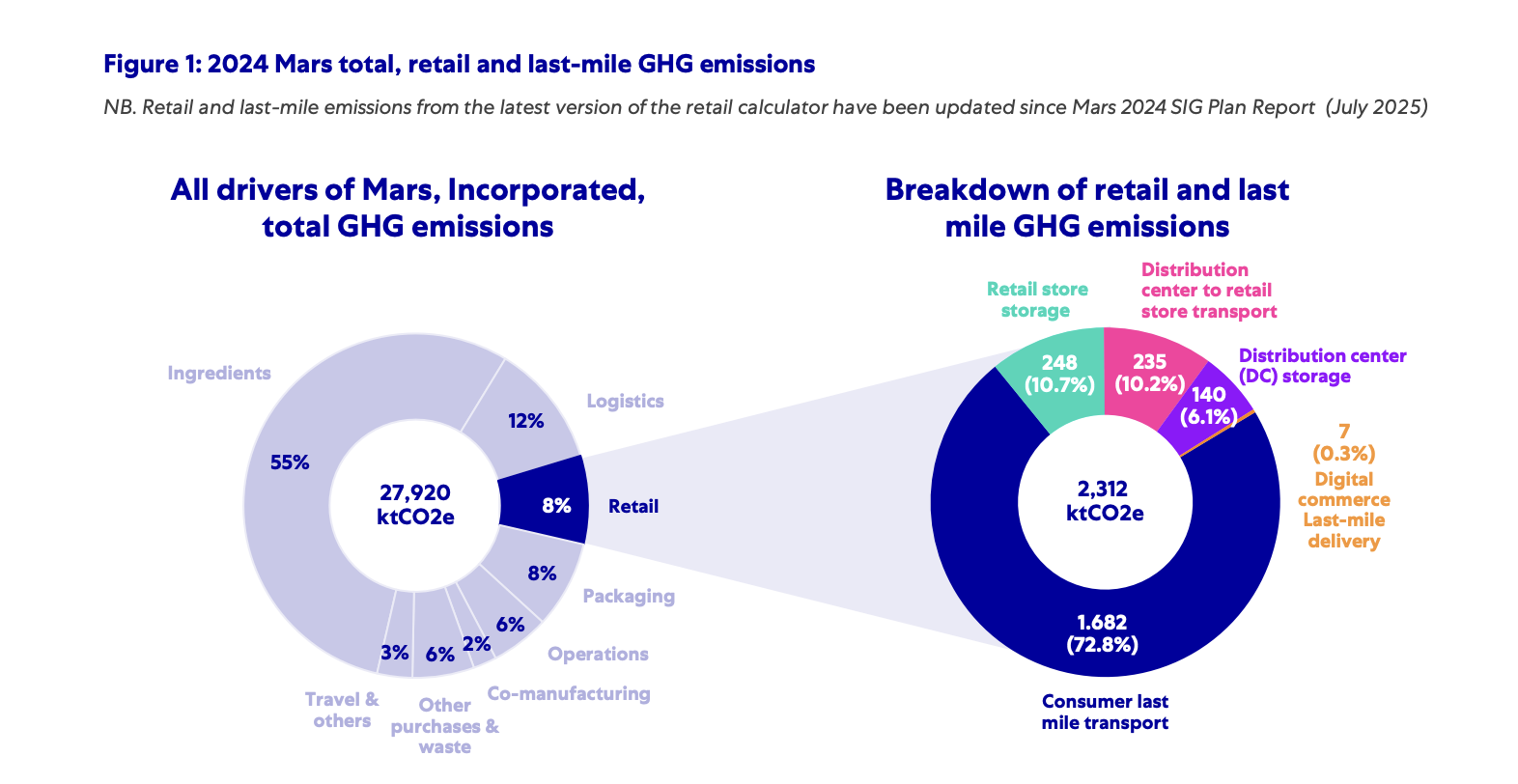
The Mars Retail Footprint Calculator has generated three key strategic insights.
- Digital commerce retail channels are at least three times less GHG intensive per unit sold compared to traditional brick-and-mortar retailing. This is due to the much higher GHG intensity of last-mile transport in a consumer’s own vehicle compared to a typical grocery home delivery vehicle. Therefore, increasing digital commerce generally reduces emissions.
- Business and product characteristics drive emissions variability: Heavier consumer shopping baskets, higher product density and chilled transport and storage requirements generate differences in retail and last-mile GHG intensity across product types and operating divisions.
- For Mars, retail scope 3 electricity usage in storage—retail stores and distribution centers—was over 690GWh in 2024. Mars plans to cover more than 85% of this usage via its RAcc program, reducing global GHG emissions for Mars by 388ktCO2e in 2024, or approximately 1% of total value chain footprint.
The calculator enables collaboration by allowing Mars to model its share of retail partners’ emissions and identify opportunities for reduction. For example, it highlights the cut in emissions possible from broader adoption of electric transportation by retailers and consumers. Looking ahead, we will use the calculator to initiate informed conversations with retail partners about sustainable business practices and proactive, regular data sharing.
We believe that as value chains evolve and climate risks intensify, static models based on spend, or salesbased industry averages, are no longer sufficient. The future of GHG accounting lies in granularity, adaptability and collaboration. The Mars Retail Footprint Calculator exemplifies this evolution by showing how available data can illuminate and clarify complex supply chains. The Calculator points towards a future of more robust GHG accounting through increased data sharing between CPG companies and retailers.
To learn more, download the full case study here(Opens a new window).


